
PROGRAM NOTES
Bernstein, Brahms & Blues
Michael Christie, conductor
Tai Murray, violin
W.C. Handy | “Saint Louis Blues”
Ravel | Blues for string orchestra
arr. Miloradovic
Bernstein | West Side Story Suite for Violin and Orchestra
arr. Bateman
Brahms | Symphony No.1 in C minor, Op. 68
– – – – – – – – – – –II. Un poco sostenuto – Allegro – Meno allegro
– – – – – – – – – – –III. Andante sostenuto
– – – – – – – – – – –IIII. Un poco allegretto e grazioso
– – – – – – – – – – –IV. Adagio – Più andante – Allegro non troppo, ma con brio, Più allegro
VIOLIN SONATA NO. 2
Maurice Ravel
Composed between 1923 and 1927.
Violin Sonata No. 2 stands as his final contribution to chamber music. It is a quintessential example of his mature neoclassical style, characterized by lean textures, rhythmic precision, and an exploration of instrumental independence.
II. BLUES (Moderato)
Reflecting Ravel’s fascination with American jazz and blues—which he encountered in Parisian cafés—this movement uses syncopated rhythms, “blue notes,” and banjo-like strumming in the violin. It provides a bold, improvisatory contrast to the more traditional outer movements.
SYMPHONIC DANCES FROM WEST SIDE STORY
Leonard Bernstein
West Side Story is a tour de force of American music; its popularity is evergreen. Arguably Bernstein’s greatest work, it has taken its place as a masterpiece, not only in the context of Broadway musicals, but also as an icon in the larger musical life of the nation. But, its genesis was not spontaneous. The composer drew upon his successful experience in writing for the stage, as well as his deep engagement with the inspiring nature of New York City—a feeling for the place that only a native could have. While he astonished all with his amazing talents in almost every musical endeavor—he shirked at nothing—it is in musical theatre that he seemed naturally to flourish. He simply understood the genre and its demands.
He had plunged in early, writing for student productions at Harvard, and working with a cabaret group (that included Judy Holiday) while at student at the Curtis Institute. At the age of twenty-six his ballet Fancy Free was first performed at the Metropolitan Opera and On the Town opened on Broadway. Wonderful Town, Peter Pan, Facsimile, Candide, and, of course, West Side Story, followed in succession. Later works, like his still-controversial multimedia theatre piece, Mass (1971), and the unsuccessful musical, 1600 Pennsylvania Avenue, some critics point to as evidence of a weakening sense of his audience and times. But his masterpiece is clearly West Side Story, and has stood the test of time as a document of the Big Apple in the fifties.
It’s a masterful blend of pop sociology, bebop and Latin jazz, and a fantastic integration of dance. Bernstein had “big” ears for the jazz idiom—and came up with a score that rather better makes the case for “symphonic jazz” than did ever Gershwin or Copland. He simply had an innate feel for dance and for jazz rhythms and harmonies to which few “legit” composers could ever aspire. The “Symphonic Dances” were gleaned from the score of the musical in 1960 by Sid Ramin and Irwin Kostal, who had collaborated on the orchestration of the original show, working from Bernstein’s piano sketches. They were masters at their craft, and the score of the whole musical reflects it. In the suite one will hear the soaring “Somewhere,” a mambo and a cha-cha, the ultra cool “Cool,” and the gripping “Rumble” music, as this synopsis of a time-shifted Romeo and Juliet reaches its inexorable tragic conclusion.
–Wm. E. Runyan
© 2015 William E. Runyan
SYMPHONY NO. 1 IN C MINOR, OP. 68
Johannes Brahms
“This is a chosen one.” Robert Schumann so characterized Johannes Brahms in his famous article that introduced the young Brahms to the public. Little did he know! Brahms went on to become the last great successor of the artistic mantle of musical Classicism that led from Joseph Haydn, through Mozart, Beethoven, and Schubert. That’s taking the rather narrow view, of course, for there were others who followed who revered the classical attributes of restraint, balance, clarity of form, elegance, and general equipoise that came to characterize the collective features that came to be known as classical style. And they stand in clear contrast to the sweeping trends and excesses of music Romanticism that came to dominate European music until the cataclysm of World War I.
Simply put, the composers of the nineteenth century after Beethoven tended to divide themselves into two groups. The progressives were true “Romantics,” and were greatly influenced by the extra-musical ideas that were the subjects of contemporary literature, poetry, and painting, among others. They devised new genres, such as the tone poems of Smetana and Liszt, the music dramas of Wagner, and the characteristic piano pieces of Chopin. Much of this music, to use a phrase still common among seekers of meaning in music, was about “something”–meaning something familiar to human experience. Liszt and Wagner, et al, while respecting the music of the past, saw no future in continuing that tradition.
Others, Brahms most significantly, still adhered strongly to the musical philosophically oriented musical style of Beethoven. He and other conservatively minded musicians held that the traditional forms of sonata, concerto, and symphony had not nearly exhausted their viability, and that music should continue to speak in an integrated language that referred to itself, alone, and certainly not to extra-musical ideas. So, he and his ilk continued to write “pure,” or “abstract” music, like sonatas and symphonies (a so-called symphony is just a sonata for orchestra). Today, most of those who compose, perform, and listen to art music see no contradiction at all in valuing both broad aesthetic viewpoints—so we enjoy the best of both worlds.
The example of Beethoven’s music loomed overwhelming for Brahms, and he waited for decades to essay his first symphony, completing it in 1876, when he was forty-three years old. Brahms was probably the most conscientious and self-critical of all the great composers, and worked on this symphony for about two decades. It garnered sufficient early success to be deemed the “Tenth,” referencing Beethoven’s nine in that genre, although it really bears more comparison with Beethoven’s fifth symphony. It has stood the test of time sufficiently to no longer bear comparisons to any of Beethoven’s works, and is now one of the monuments of the greatest musical compositions of Western Civilization.
It begins austerely and rather abstractly—timpani pounding away–with simple musical elements that come to permeate the entire first movement. This slow introduction is soon followed by the faster movement proper, which weaves a tapestry of motivic manipulation, thorough integration of ideas, and masterful polyphonic textures. You’re not likely to walk away whistling the tunes, but rather with the feeling that you have heard music that offers more details to enjoy than one listening can absorb. The second movement opens with an incredibly rich, warm statement by the string section. A subsequent theme is intoned by the solo oboe and then the solo clarinet. Brahms works through these ideas in the same contemplative, pastoral mood and before long, the solo horn announces the coda. But, we’re glad that the composer takes his time in gently bringing this meditation to a profound and tranquil end. The third movement is a happy jaunt through nature, opening with the solo clarinet. Other ideas are heard, but the initial tune returns from time to time to keep us on track. A skipping middle section in six-eight time provides some diverting, yet optimistic activity, but soon our familiar first section returns—suitably varied, of course. And then this sunny diversion is over before you know it.
Notwithstanding all of the treasures of the first three movements, the last movement is the star of this symphony. It begins ominously, and with a bit of uncertainty as to where it will take us, but that is soon cleared up by the glorious solos in the horn (inspired by the Swiss alphorn—think of Ricola commercials on TV) and flute. The famous trombone chorale is heard, letting us know that this is serious stuff, and then we’re ready for the main event. A rich, hymn-like theme is heard in the low register of the strings (you’ll be able to sing this one), and we’re off. What follows is a treasure trove of distinct and ingratiating themes, all of which are worked through such as to engender an almost overwhelming anticipation of the spacious and grand ending. The chorale, first heard softly at the beginning in the trombones, is reserved for a monumental rendition at the end—an almost overwhelming statement of joy, power, and triumph of the good.
From ominous beginning to exultant end, this glorious work is ample evidence of Brahms’ almost unique combination of profound, emotional feeling combined in eloquent restraint with highest intellectual techniques. It illustrates perfectly why so many orchestral musicians unhesitatingly cite this composer as their deep, personal favorite of them all.
–Wm. E. Runyan
© 2015 William E. Runyan
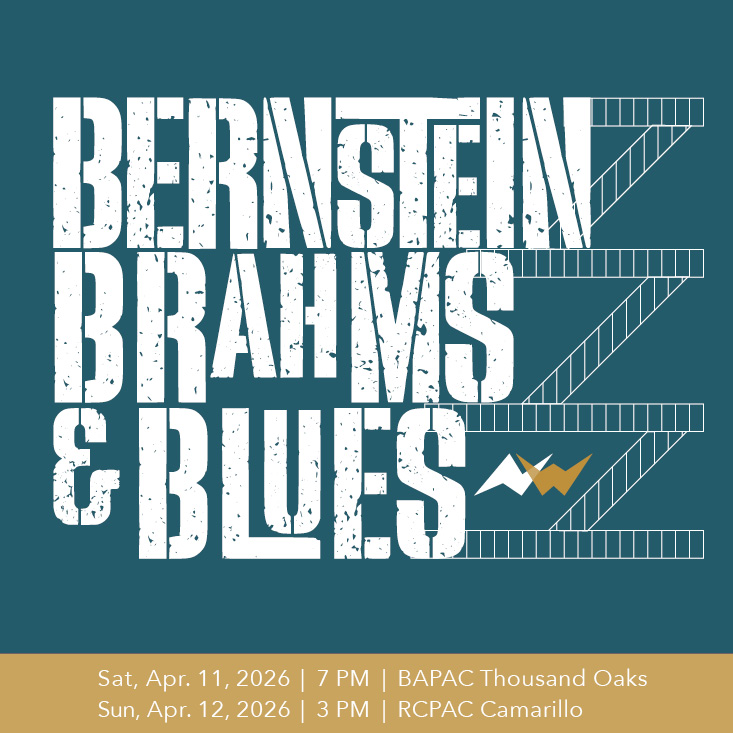
Saturday, Apr 11 | 7 PM
Bank of America
Performing Arts Center (BAPAC)
Thousand Oaks
Sunday, Apr 12 | 3 PM
Rancho Campana
Performing Arts Center (RCPAC)
Camarillo