
PROGRAM NOTES
Rachmaninoff & Gershwin
The Stars and Stripes Forever March
John Philip Sousa
(b. Washington D.C, November 6, 1854; d. Reading, PA, March 6, 1932)
First performance: May 14, 1897 in Philadelphia
Duration: approximately 3 minutes
Composed by the “March King” John Philip Sousa in 1896, “The Stars and Stripes Forever“ stands as America’s most beloved and recognized patriotic march. Its enduring power to “arouse the patriotic spirit” led the U.S. Congress to designate it the official National March of the United States in 1987.
Sousa often shared that the march was born of homesickness and divine inspiration during his return voyage from Europe in late 1896. While pacing the deck of the ocean liner after learning of his manager’s sudden death, a “mental band” played the melody in his head, a vision of the American flag that was so vivid he “could not get back under it quick enough”. He committed the notes to paper upon his arrival in the United States, completing the composition on Christmas Day.
The march follows a traditional structure, but it is the final trio section that makes it instantly recognizable and a favorite for audiences and musicians alike. This section famously features a broad, lyrical melody (meant to represent the North), a bold countermelody in the trombones (representing the West), and a soaring, intricate piccolo obbligato (representing the South), which has become a signature and challenging part of the piece.
The combination of spirited melodies, dynamic contrasts, and the iconic piccolo solo creates an energetic and celebratory anthem that perfectly captures the optimism and unity of the American spirit. Today, it remains an essential piece at patriotic events, military ceremonies, and Fourth of July celebrations across the nation.
PIANO CONCERTO NO. 2 IN C MINOR, OP. 18
Sergei Rachmaninoff
Those who create art, whether in the performing arts or in the visual arts, inevitably find their personal “niche” in matters of style. And it is of little consequence whether or not their artistic orientation is a conscious personal choice, or one seemingly imposed by their audiences and by professional critics. Simply put, there are artists whose voice naturally is to work within tradition and commonly-understood artistic language; they strive to develop that tradition to new levels of meaning through their own talent and personal vision. Others make a total commitment to artistic truth arrived at through new voices, new styles, new languages. Every museum and gallery of art, and every concert hall is testimony to this essential dichotomy. And it must be admitted, that there a universal prejudice among intellectuals—especially those who subconsciously view the arts as they do technology—that the new is necessary the good. The latest styles are more sophisticated, hence more relevant, and old styles should be left with the dead artists that created them. This popular view was dominant among the cognoscenti during most of the twentieth century, but is beginning to moderate, as a more liberal acceptance of diverse artistic styles now is more common than previously—in all the arts.
Like J. S. Bach, who upon his death was looked upon as more or less an old fuddy-duddy (now we know better, of course), Rachmaninoff has borne his share of criticism for having composed in a hopelessly old-fashioned style, long after its relevance. His compositions are the last major representatives of vivid Russian Romanticism—long after that style was presumed dead and buried. Yet, like Bach, his musical genius, his talent, and his strong belief in the validity of his art all led him to create a legacy that took “old-fashioned-style” to a natural and valid high point of achievement. While a child of the nineteenth century, he died almost at the midpoint of the twentieth, secure in his success, and secure in the world’s enduring appreciation of his “dated” style.
Rachmaninoff wrote four piano concertos, the first was a student composition (later revised) from 1896 and the last was composed in 1926 (revised in 1941). The second is by far the most popular, and was finished in 1901, when the composer was twenty-eight years old, and had just undergone a devastating series of professional setbacks that cast him into deep depression. It contains all of the essential characteristics of Rachmaninoff’s style that have established his lasting place in audiences’ esteem everywhere. An unparalleled melodic sweep, the lyricism of which seems to unfold in growing cascades of sound, is coupled with masterful orchestration of rich, lush textures. The composer was a virtuoso pianist and his writing for the solo piano emanates from a mastery of the almost limitless figurations possible for the instrument. Although Rachmaninoff left Russia after the Revolution, never to return, and lived in a variety of places—at his death in 1943, he was living in Beverly Hills—he lived as a Russian all of his life. That is, he and his wife maintained a home with Russian servants, spoke Russian there, and lived with Russian customs.
That ethnicity speaks eloquently in almost every bar of his music, and anyone can sense that from the first ominous chords that build the tension before the entrance of the main theme in the second concerto. The darkness of the mood is enhanced by the simple choice of register for that theme, for it is scored for unison low strings and clarinet, right at the bottom of the violins’ range. The winsome second theme, in a happier mode, is pure Rachmaninoff. The middle of the movement is suitably restless, in a varied tapestry of themes, keys, and textures, leading to a climax, where we expect the usual review of the opening. But, the composer, ever creative, turns things upside down, and we hear quite a different closing section than is usual. New ideas and relationships add considerably to the charm of the movement, as it builds to the inevitable climax at the end.
The slow movement finds the piano ruminating with figurations that leads one to ask: “Where is the theme?” The flute provides the answer, in a delicate solo that leads to a series of exchanges between the solo piano and other instruments in a languorous atmosphere that is now thought of as a trademark of the composer. Even if you don’t have perfect pitch, there is an indefinable satisfaction gotten from the unexpected choice of key for this movement, a rather unusual relationship between E major and C minor.
The last movement, of course, is the one with the melody made so famous during the 1940s in a maudlin pop arrangement. For all of that, to the present, this concerto continues to be a source of musical elements ripped from it and used in unexpected contexts. In any case, after a few gestures in the lower instruments, the soloist kicks the movement off with a grand cadenza that teases us as to where the movement could possibly go. The answer is a dynamic march of a theme, snapping along. The “big, lyrical theme” is the contrast, introduced by the warm, rich viola section. Exciting give and take between the two ideas propels the movement along, until the “big, lyrical theme” wins the day, and soars rhapsodically to the majestic ending that only a grouch would denigrate. The years in Rachmaninoff’s life immediately before the composition of this work may have been low ones for the young man, but this concerto is apt testimony to the palliative effects of a good therapist and marrying your sweetheart.
–Wm. E. Runyan
© 2015 William E. Runyan
FANFARE FOR THE COMMON MAN
Aaron Copland
For the 1942-43 concert season, the distinguished English conductor of the Cincinnati Symphonic, Eugène Goossens, conceived the idea of commissioning fanfares from mostly American composers to open each of the forthcoming concerts. Those were dark times, indeed, for the world’s democracies, and he sought to more or less repeat his success with a similar project in England during the First World War. The subsequent eighteen fanfares were written by many luminaries of the American music world at that time, and they vary significantly in musical style—and lasting success. The list of those to whom the various works were dedicated may seem a bit curious to us today, but they do reflect somewhat the unfocussed—some would say naïve—conception of the task ahead as America went to war. All of them are eloquent, earnest responses to the world at hand. Some titles seem prosaic: Fanfare for the Signal Corps by Howard Hanson; some seem ambiguous: A Fanfare for Friends by Daniel Gregory Mason; and some a bit optimistic: A Fanfare for the Fighting French by Walter Piston. But only one has survived on concert programs—and everywhere else—and become a defining icon of America’s self-perception.
Aaron Copland was a committed populist during the 1930s—his enormously successful works from that time certainly bear that out—and what better dedicatee for a man of his persuasion than the “common man?” And for that matter, what better inspiration for the idea than the words of the Vice-President, Henry A. Wallace? Wallace, a controversial, but sincere, advocate of left-wing social and political views had given an important speech–and later entitled a book—with the phrase, “century of the common man,” and Copland, given his political orientation, would certainly have found resonance in the thought. That it bore fruit in the composer’s psyche is self-evident.
Scored for the brass and percussion sections alone, its granite-like octaves and unisons, and open “American Sound” harmonies, punctuated by stentorian utterances from the percussion have assumed an unprecedented life in our musical culture. Even when alluded to abstractly by the legions of composers who have sought the feeling and sound of this remarkably concise work—we “know” instinctively what is being invoked. Copland knew that he had a gem on his hands, and soon used a version of the fanfare as the main theme of the last movement in one of his most important works, the Symphony No. 3. The latter work—first performed in 1946–was openly characterized by the composer as reflective of America’s mood, having triumphed over an overwhelming challenge to its very existence. Seldom does art and popular feeling coalesce in such profound unanimity. The fanfare is now a national treasure.
–Wm. E. Runyan
© 2015 William E. Runyan.
CATFISH ROW
George Gershwin
George Gershwin was arguably the most successful and talented of America’s composers of popular music. His songs constitute the core of the “American Songbook,” whether composed as part of his immensely successful Broadway shows, or as stand alone popular tunes. Born of Russian Jewish immigrants, he didn’t evince his formidable musical talents until about the age of ten, when a piano was purchased for his older brother and later collaborator, Ira. Much to the latter’s relief, George soon commandeered the piano, and the rest is, as they say, history. His audiences rewarded him substantially—he is estimated to have become the wealthiest composer in modern times. He earned over a quarter of a million dollars for Rhapsody in Blue during the first decade of its life, and it still is bringing in the bucks, as witnessed by the commercials for United Airlines.
What is specifically germane to appreciating Catfish Row is the importance of so-called “serious” or “classical” musical interests and training in Gershwin’s life that is quite unprecedented for someone who enjoyed his kind of success. He certainly was not some sort of untutored musical genius who later sought “legitimacy” after having proven himself in the popular world. Rather, early on, as a young boy he studied and performed under traditional piano teachers the music of composers such as Chopin, Liszt, and Debussy. Later, he journeyed to Paris to study under the famed teacher of composition, Nadia Boulanger, as well as Maurice Ravel. However, both rejected him, more or less afraid to compromise the genius evident in his burgeoning success. While in Paris he met and admired the music of eminent composers such as Prokofiev, Poulenc, and Milhaud. It is important for an understanding of Gershwin’s ambitions to realize that long after he had achieved the kind of success that any popular composer would have envied, he assiduously studied formal composition with established teachers. And he was successful. His Rhapsody in Blue, the Concerto in F, An American in Paris, and Porgy and Bess are masterpieces of his unique bridging of the so-called gap between popular art and “high” art. It is amazing that until recently otherwise intelligent people debated whether or not Porgy and Bess was really a “legitimate” opera. Now we know better—especially now that it is enjoying revivals that are true to the original 1935 version.
Gershwin prepared the orchestral suite based on the opera shortly after the show closed in New York City after 124 performances—not enough to recoup the financial investment. It was completed by Gershwin in January of 1936, and given its premiere by the Philadelphia Orchestra that same month. Only later did Ira change the name of the suite to Catfish Row. There are five sections in the work: Catfish Row, which begins with “Jazzbo Brown’s Piano Blues,” and goes on to the familiar “Summertime.” Porgy Sings follows, with “I Got Plenty o’ Nuttin” and “ Bess You Is My Woman Now,” separated by an interlude played by a solo cello. The third section, Fugue, showcases music in an advanced style, not normally associated by audiences with Gershwin. In the opera these passages are from the scene of the murder of the despicable Crown. Hurricane obviously comes from the intense storm section in Act II of the opera, and the fifth section, Good Morning, Brother, contains music that was cut from the opera, and then goes on to conclude the suite with the familiar Oh, Lawd, I’m On My Way, sung by Porgy as he courageously starts off for New York in his pathetic goat cart.
–Wm. E. Runyan
© 2015 William E. Runyan
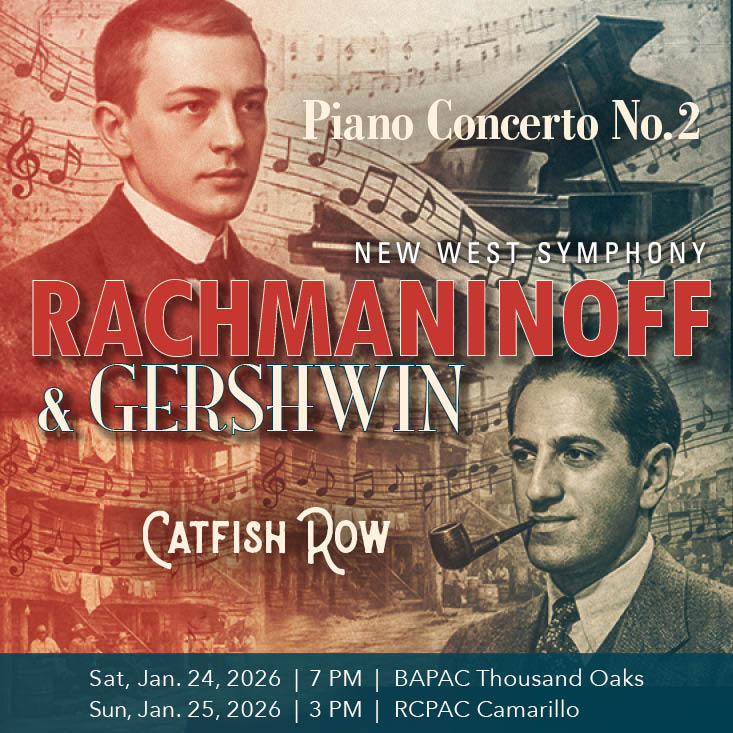
Saturday, January 24 | 7 PM
Bank of America
Performing Arts Center (BAPAC)
Thousand Oaks
Sunday, January 25 | 3 PM
Rancho Campana
Performing Arts Center (RCPAC)
Camarillo