
PROGRAM NOTES
Mozart and American Voices
Wolfgang Amadeus Mozart composed The Marriage of Figaro in 1786. At the same time, the United States, now in an embryonic state and governed loosely by the Articles of Confederation, was realizing significant challenges posed by a weak federal government. The Annapolis Convention of 1786 was called by leaders such as James Madison and Alexander Hamilton to draft a report that ultimately led to the Philadelphia Convention, and the United States Constitution.
Meanwhile, Mozart was at the height of his powers in Vienna. In the years surrounding Marriage of Figaro, he would also compose some of his most notable operas, The Abduction from the Seraglio, Figaro, and Don Giovanni, before entering the troubled era that would hasten his demise. I have extracted several glorious scenes and arias that merely scratch the surface of this masterpiece.
During the first half of the 20th century, increasing numbers of theater works incorporated spoken dialogue, diverse popular musical styles, and eventually amplification, making permanent a divide between opera and musical theater. I think this is such a sad development, especially for opera. On the topic of microphones, I think opera becomes more accessible if they are brought into the mix. (I’m happy to debate the topic if you’re inclined!) Nevertheless, both genres have been an important part of the American music formula. We start with the great Harry Burleigh. Burleigh introduced Antonín Dvořák to African American spirituals during his notable stay in New York that brought us the New World Symphony. Aaron Copland, the “Dean of American Music,” also used American folk music as he brought voices into his distinct American musical palette. Stephen Sondheim was a central figure in the development of American musical theater. He started his career working with Leonard Bernstein on West Side Story, and would go on to write sixteen original Broadway musicals and win dozens of international awards for nearly seventy years of work including the fun songs on this program. It was impossible to pick “the best” because everyone has their own favorite. While we celebrate America’s 250th birthday I thought it would be fun to bring the Kennedy White House into the mix! Leonard Bernstein looms large over any survey of American music for sure. Candide and West Side Story were written concurrently, tackling satire and tragedy, respectively. Even after attempting to draw a line between opera and musical theater, as I did above, Bernstein seems to have found an absolutely delightful middle ground that keeps this big music dancing – defying any sense of gravity.
OVERTURE TO THE MARRIAGE OF FIGARO, K. 492
Wolfgang Amadeus Mozart
Mozart’s incomparable musical gifts enabled him to compose at the highest level of artistic brilliance in almost every musical genre. We are privileged to experience his legacy in symphonies, chamber music, wind serenades, choral music, keyboard music—the list goes on and on. But, unquestionably, his greatest contributions to musical art are his operas. No one—not even Wagner, Verdi, Puccini, or Richard Strauss excelled the perfection of Mozart’s mature operas. The reason, of course, is clear: his unparalleled musical gift is served and informed by a nuanced insight into human psychology that is simply stunning. His characters represented real men and women on the stage, who moved dramatically, and who had distinctive personalities. While Mozart composed both comic operas and serious operas, and in both German and Italian, his major body of work lies in his opera buffe–Italian comic operas.
Mozart’s first opera was performed when he was eleven years of age, and he composed fairly steadily in the genre thereafter, writing well over a dozen before the “big four” of his immortal Italian operas of the late 1780s. In the first of these, The Marriage of Figaro (1786), Mozart’s librettist, Da Ponte, based the story upon the second “episode” of Beaumarchais’ famous trilogy of plays. You may recall that the first is the basis of Rossini’s “Barber of Seville.”
Generally, in his late operas, Mozart incorporated some thematic references to the opera proper in the overtures. Not so here! This sizzling curtain raiser nonpareil is unique and unequalled in setting the mood and preparing the audience for almost four hours of intrigue, betrayal, and skullduggery in general. Almost unassumingly the unison strings plunge into the beginning—the pianissimo dynamic coupled with the breathtaking tempo giving ample warning of the intrigue and pace that lies ahead in the drama. And it doesn’t relent in its driving tempo, right to the end. There are loud parts and there are soft parts, inimitable themes—but the drive is relentless. When it finally ends, no audience is as ready for an evening with a masterpiece of opera as those attending The Marriage of Figaro; the overture’s genius serves it equally well as a stand-alone composition of the highest order.
–Wm. E. Runyan
© 2015 William E. Runyan
OVERTURE TO CANDIDE
Leonard Bernstein
Thirty-five years after Leonard Bernstein’s death, the critics are still arguing over the meaning and impact of his legacy. What is clear, however, is that the world rarely enjoys the genius of someone who excels supremely in so many artistic endeavors. Pianist, conductor, television personality, teacher, mentor, social gadfly, and composer of both popular musical theatre and “serious works,” Bernstein wore all hats with avidity. And he enjoyed stunning success in most. He had a passion about everything that he essayed, whether conducting the Mahler that he loved so well, or helping audiences “peel” apart the mysteries of music in his many teaching rôles. He knew so much, and could do so much, that he genuinely thought that he could do it all. His leadership of the New York Philharmonic Orchestra and other orchestras is legendary, but everyone knows there were some concerts that, frankly, got away from him in his self-indulgence. He worked assiduously as a composer of “serious” music, but those works—from youthful successes to his late efforts–have enjoyed mixed success. But, all that simply says is only that he was human. Other than his epochal conducting, there is one field in which he garnered almost universal acclaim, and that is musical theatre. When all is said and done, he possessed a talent and a facility for the stage that was as deep as it was prolific. He simply understood the genre and its demands. He plunged in early, writing for student productions at Harvard, and working with a cabaret group (that included Judy Holiday) while a student at the Curtis Institute. At the age of twenty-six his ballet Fancy Free was first performed at the Metropolitan Opera and On the Town opened on Broadway. Wonderful Town, Peter Pan, Facsimile, and Candide soon followed, as it seemed that everything he touched became gold.
Based upon Voltaire’s well-known novella, Candide, the original Broadway musical, opened on the first of December in 1957. It was not a smashing success early on, but over the years—and through many versions, and a changing cast of writers and contributors—it has achieved an enduring place in the musical theatre repertoire. Its innate wit, sparkle, and general “cheekiness” was natural fodder for Bernstein’s own musical personality, and his songs for the production have come to personify the whole rollicking enterprise.
The overture is crafted from a buoyant mélange of some of the most memorable tunes from the show, and has become one of the most-performed works by an American composer on symphony concerts. The “catchy” tunes are cleverly cast into asymmetrical rhythmic patterns (a typical Bernstein trait) that keep the bouncy drive going as this brief work careens to the end. After all these years, it may seem that all of the tunes are vaguely familiar, so enduring is the work. The overture to Candide has taken its place along with much of West Side Story as representative of one of America’s most multi-talented and influential musicians, and is a perfect curtain opener that is thoroughly American.
–Wm. E. Runyan
© 2015 William E. Runyan
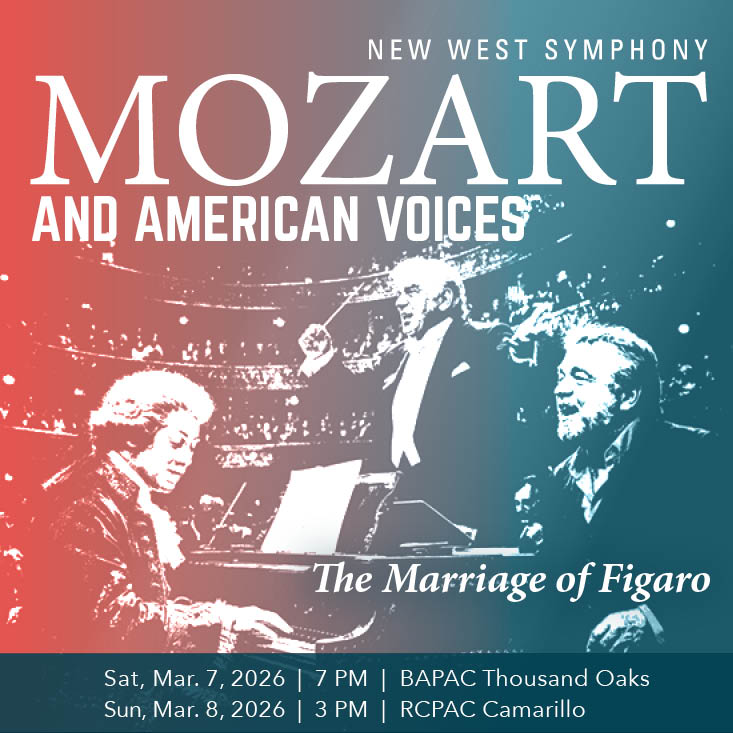
Saturday, Mar 7 | 7 PM
Bank of America
Performing Arts Center (BAPAC)
Thousand Oaks
Sunday, Mar 8 | 3 PM
Rancho Campana
Performing Arts Center (RCPAC)
Camarillo