
PROGRAM NOTES
Symphony Goes To Cirque
Festival Overture on the “American National Air”
– Dudley Buck
In 1879, one of America’s leading American composers—Dudley Buck (a name often neglected today)—wrote a Festival Overture to celebrate Independence Day. The seven-minute piece for full orchestra was based on the melody of “The Star-Spangled Banner” or what the composer called the “American National Air.” Both the national music festival and Key’s patriotic song had long offered winning strategies for Buck, one of America’s pioneering classical composers whose career predates the cultural institutions, universities, and professional orchestras that would more effectively support future generations of American composers.
Just over a decade before the premiere of his Festival Overture, Buck had composed his popular solo organ work Concert Variations on “The Star-Spangled Banner” (1866, pub. 1868). Buck was then commissioned by famed bandleader Patrick Gilmore to compose a festival cantata for the 1872 World Peach Jubilee and International Music Festival. The composer’s resulting Festival Hymn “Peace and Music” propelled him to public recognition outside the organ and sacred music circles in which he was already recognized. This led to an invitation from the U.S. Centennial Commission to create another festival cantata, this time for the nation’s 100th birthday party—a huge exposition and arts festival to be held in Philadelphia in 1876. The Centennial Meditation for Columbia on a poem by Sidney Lanier led to further praise and certainly demonstrated to Buck the career value of patriotic festivals to the aspiring American composer at a time before radio, before recording, and when only one of today’s professional ensembles (the New York Philharmonic) had been founded.
SCHEHERAZADE, OP. 35
– Nikolai Rimsky-Korsakov
Nicolai Rimsky-Korsakov’s career stood in the very center of Russian musical life of the second half of the nineteenth century. His first career was in the Russian navy, but he soon garnered success in music. Known primarily for his fifteen operas, he was instrumental in the rising importance of that genre in Russia. In addition to his fame and influence as a composer, he was also head of the conservatory in St. Petersburg–today, his statue dominates the little park directly across the street from the conservatory and the famed Mariinsky Theatre. In the West, of course, we know him primarily for Russian Easter Overture and the tone poem, Scheherazade. His ability as an orchestrator and teacher of orchestration is one of his many legacies–Igor Stravinsky was one of his students. In fact, much of the marvelous musical atmosphere that audiences adore in Stravinsky’s early ballets, the Rite of Spring, Firebird, and Petrouchka, lead directly back to Rimsky-Korsakov and the orchestral style of his operas. And it is of no small interest that there are sections in Debussy’s La Mer and Ravel’s Daphnis et Cloé that seem lifted right out of Scheherazade. A fascination with the exotic, and with non-Western subject matter was a prime characteristic of Romanticism, and Russian music of the late nineteenth century is exemplary of this predilection.
Scheherazade, completed in 1888, was inspired by the well-known story, One Thousand and One Arabian Nights. The eponymous heroine must entertain her bridegroom, the murderous sultan, with continuous intriguing tales in order to forestall the arrival of the executioner who had beheaded a thousand previous wives the morning after their successive marriages. While Rimsky-Korsakov more or less disclaimed his well-known reputation for his evocative musical Orientalism, his abilities therein certainly created a triumph of exotic atmosphere in Scheherazade. The four movements–following their titles, which Rimsky-Korsakov later withdrew—allude to four stories of Scheherazade, the sultana. We can follow loosely the narrative, for Scheherazade is represented by the elaborate, highly figured violin solo that constantly weaves in and out of the texture as the stories unfold.
The first movement, “The Sea and Sinbad’s Ship,” opens with a bold stentorian motive, which one may be tempted naturally to associate with “The Sea,” nevertheless Rimsky-Korsakov himself indicated that it depicts the bloodthirsty sultan. But soft woodwind chords—redolent of Mendelssohn–introduce the narrator in the form of the rhapsodic solo violin. The opening motive, the material in the “narrative” solo violin, and just a couple of other ideas, are all that the composer needs to weave out this little “tone poem” of the sea, whether a rough one or a serene one. The sultan, the sea, the ship, and Sinbad–its all there in the rhapsody.
–Wm. E. Runyan
© 2025 William E. Runyan
FINLANDIA, OP. 26
– Jean Sibelius
The compositions of Jean Sibelius constitute a case study in the capriciousness of musical taste and the power of the artistic avant-garde. Pigeonholed by many as primarily a Finnish nationalist, whose dark, remote music was a shallow representative of Romanticism’s last gasp, Sibelius was nevertheless deemed the champion of American and British conservative musical tastes between the world wars. Typical was Olin Downes, music critic of the Times, whose relentless public support of Sibelius bordered on sycophancy. Likewise, Koussevitsky, conductor of the Boston Symphony Orchestra, programmed a cycle of Sibelius’s symphonies, and dogged the composer to finish the eighth—which he never did. But those who favored the avant-garde of Stravinsky, Schoenberg, and company—and that included most of continental Europe and American intellectuals—were scathing in their contempt. One respected and well-known critic entitled an essay about Sibelius, “The Worst Composer in the World.” These controversies, and Sibelius’s life-long struggle with alcoholism and depression no doubt played a signal part in his composing nothing of significance from the nineteen thirties until his death in 1957 at the age of 91.
But today Sibelius enjoys a respect, while not approaching the heights of pre-World War II times, that seems to secure his reputation. While he was a prolific composer, and his symphonies enjoy frequent performance, none of his works achieved the popularity of Finlandia. Finland had for centuries languished under the rule of Sweden, and then in the early nineteenth century fell under the control of Russia, becoming by the end of the century a grand duchy of the Russian Empire. After tightening control of Finland by Russia in 1898, the Finns were distinctly unhappy. Surging nationalism manifested itself in variety of ways, including a patriotic melodrama given in 1899 in Helsinki, ostensibly to raise money for a newspaper pension fund. Sibelius contributed incidental music to this enterprise, the last tableau of which was entitled Suomi Herää (Finland Awakens). He reworked the piece into a symphonic tone poem the next year, and renamed it Finlandia. It opens with ominous brass chords, moves on into a tumultuous faster section that seems to parallel a growing national sense of strength, and ends triumphantly with a powerful chorale (heard earlier, in a soft aura of confidence). The chorale has entered the realm of popular church music under the title, “Be Still My Soul,” but it stands alone as the most affirmative statement of the confidence and independence of the Finnish people.
–Wm. E. Runyan
© 2015 William E. Runyan.
NIGHT ON BALD MOUNTAIN
– Modest Mussorgsky
Mussorgsky is, of course, familiar to concertgoers for his ever-popular work for solo piano, Pictures from an Exhibition—made even more well known in Ravel’s masterful orchestration. Opera lovers occasionally are afforded the opportunity to attend a performance of his stunning opera, Boris Godunov, but for most, that’s it. For the great preponderance of his work is encountered through his many songs, well known to singers and teachers of voice. The single exception to this is manifestly his evergreen tone poem, Night on Bald Mountain—except that he didn’t compose it. Well, not in the conventional sense of a complete, polished composition. For it has a checkered history, to be sure.
A tone poem is a single movement for orchestra that, in the best romantic tradition, is about something other than its straightforward musical elements. Composers of the eighteenth century were quite satisfied with music that stood on its own: first theme, second theme, etc. But, our passionate romantics of the nineteenth century were also interested in composing music that took as its inspiration a picture, a story, a poem–anything that could stimulate the imagination. So, by the late 1840s this trend was in full swing, led by the inimitable Franz Liszt. Our young Modest Mussorgsky was quick to pick up on the trend, and so was inspired around 1858 to compose a work partly drawn from recycled elements of an opera abandoned earlier that definitely had a romantic focus: witchcraft and deviltry, tentatively entitled, St. John’s Night on Bald Mountain. Some years later, twenty-eight years old, and spending the summer of 1867 on his brother’s farm, he further developed the idea into an orchestral work, now called “The Witches.” He offered it to his colleague, Balakirev, for performance on a concert of the Russian Music Society. The latter was severely critical of the work, and the composer withdrew it. That was the practical end of the matter for Mussorgsky, for he never worked on or edited the work, although he did attempt to include elements in two subsequent operas. But, he never heard it performed as he had conceived it—an orchestral work. Fast-forward to years later, after the composer’s death, when distinguished composers and music scholars were assiduously—but misguided, to be sure—busily working over Mussorgsky life’s work, “correcting” his supposed crudities and fundamental compositional mistakes. The eminent Russian composer, Nikolai Rimsky-Korsakov, was chief among these do-gooders, and he took it upon himself to more or less re-compose Mussorgsky’s Night on Bald Mountain. The result was a work that was as much Rimsky-Korsakov’s as that of Mussorgsky. Given its première in 1886, it became the version heard almost exclusively ever since. Well, it may be mostly by Rimsky-Korsakov, based upon Mussorgsky’s themes, but it’s a corker, nevertheless, and justly beloved.
The story is simple. For those not familiar with the details of the Christian ecclesiastical calendar, the feast day of St. John the Baptist is exactly six months before Christmas, thus (generally) occurring on June 23rd. Throughout the Christian world, for many, many centuries, the eve of the holiday was popularly thought of as the province of the Devil and his minions, but other traditions simply invoke old, Summer Solstice observations. Every country in greater Europe still has its own version of traditions, many of which invoke various nefarious characters and their evil deeds on that night. There are various rocky promontories—mostly Slavic–upon which these “black” celebrations occur, the most famous being the Lysa Hora in Kiev, Ukraine. Rimsky-Korsakov included a brief description of the “story” in his score. Following it, the work begins with “subterranean sounds of non-human voices, followed by the appearance of the spirits of darkness.” Thereupon an evil “black god,” traditional in Slavic countries, materializes, and presides over a “Black Mass.”
–Wm. E. Runyan
© 2017 William E. Runyan
AMERICAN SYMPHONETTE NO. 2
– Morton Gould
While Leonard Bernstein is often seen as the multifaceted American musician who wore just about every musical hat—the garland could just as easily be shared with Morton Gould. What didn’t he do—and stunningly successfully? He was literally a household name during the nineteen forties and fifties, and was an active composer into his eighties. A child prodigy, he composed from a remarkably early age. By his late teenage years he was playing professionally in movie theatres and vaudeville, but got his big break as the staff pianist in 1932 for the newly opened Radio City Music Hall. Positions as conductor and arranger on national radio shows soon followed, as well as commissions for music for Broadway shows, film, ballets, and ultimately, television. His purview was certainly not limited to “popular” music, for he conducted many of the great symphony orchestras all over the world, often appearing as piano soloist, as well– Rhapsody in Blue was a specialty. Compositions flowed from his pen by the dozens with ridiculous ease, and a remarkable number of almost every ilk ensued. Pieces for American bands, symphony orchestras, chorus, concertos—including one for “rapper” and orchestra. The variety of styles and genres is simply astonishing.
He could plumb the depths of American popular culture, as well the aspirations of “higher, classical” art with an almost effortless equal facility—what is perhaps most impressive was his mastery of both approaches to musical composition. While both Bernstein and Gershwin were undeniable musical geniuses, it must be admitted that they struggled somewhat to find a facile musical voice that poured easily into the forms and structures of more formal musical composition—not so with Gould. He spoke as easily and with equal, natural facility in a “symphony” as he did in a piece for singing fire department.
The series of “symphonettes” for orchestra are cases in point. Composed at various times during the nineteen thirties and early nineteen forties, they are charming short essays in the symphony genre, and are completely smooth idiomatic explorations of its “classical” norms. The title is a bit whimsical, the composer alluding to the vogue of the time to tack on “-ette” to almost anything: dinette, kitchenette and even Buick and Cadillac “sedanettes.” Like so many “cross-over” compositions of the time, this little “symphonette” (composed for a 1938 radio show) is infused with jazz-like elements in each of its three movements. The first is appropriately in a kind of sonata form, and the second is a traditional dance form, in this case a rather sedate pavan, one of Gould’s most famous tunes. The muted trumpet and “walking” bassoon accompaniment are instantly recognizable from myriad performances. The last movement, in the best symphonic tradition is a scampering affair that the composer admits is a “slight takeoff on the Prelude from Bach’s E-major unaccompanied Violin Partita.” That may be, but essentially it is an adroit example of late 1930s through early 1950s happy, urban, East Coast, jazzy soundscapes so familiar from, say, West Side Story and a thousand movies.
–Wm. E. Runyan
© 2026 William E. Runyan
A MUSIC FROM THE OPERA CARMEN
– Morton Gould
Georges Bizet was a genuine musical prodigy, whose talent was early and widely recognized, who studied with the best teachers and composers in France, who perhaps was the close equal of Liszt as a pianist, who won the Prix de Rome, and who composed perhaps the most popular opera of all time. And yet–his career was a checkered one, full of missteps, works that were never finished, works that were finished and not performed, betrayals and failures with the French operatic establishment, and an early death. He planned, started, or substantially worked on some thirty operas, but finished only about five, of which only two achieved success. His musical legacy was a story of lost manuscripts, poor or no scholarly attention, bad editions, and general neglect. Today, the American musical public knows his work almost entirely through his immortal opera Carmen, and to a lesser degree, the opera The Pearl Fishers, as well as his orchestral suites of incidental music from the play, L’Arlésienne. The situation is only somewhat better in Europe–even in his native France. While he did compose a substantial body of work, it was admittedly irregular in quality–certainly in reception. Moreover, to survive financially, he was reduced to spending much of his musical life arranging the music of other composers.
But there is Carmen. It clearly is one of the greatest operas of the nineteenth century, and takes a place of honor among all in the genre. After all the failures, disappointments, and false starts, Bizet hit pay dirt with this one. He worked on it during 1873-4, and its première took place at the Opéra-Comique in Paris in March of 1875. It was not an easy birth. The orchestra complained about the difficulty of the score (“unplayable”); the singers said the orchestra was too loud; the women in the chorus resented having to smoke and fight on stage. And more. But the opera was a success, owing perhaps as much to its perceived scandalous nature as anything. And poor Bizet died shortly after two heart attacks in May at the age of thirty-six.
Now, of course, everyone appreciates Bizet’s colorful, but relatively light, orchestration, and his real ear for tonal color that well suits the opera’s Spanish setting. Even the master of orchestration himself, Richard Strauss, recommended students of the subject to Carmen, not to Wagner. Its evocation of Spain is matchless, and its realism on the stage made operatic history. The two suites extracted from the score by his friend, Ernest Guiraud, quickly entered the standard repertoire for orchestra, and have remained so.
–Wm. E. Runyan
© 2015 William E. Runyan
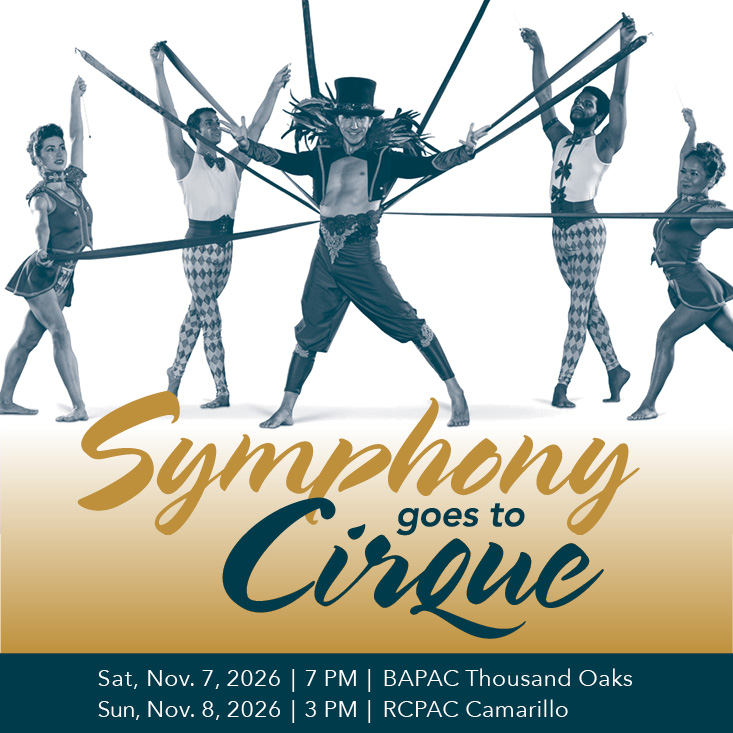
Saturday, November 7 | 7 PM
Bank of America
Performing Arts Center (BAPAC)
Thousand Oaks
Sunday, November 8 | 3 PM
Rancho Campana
Performing Arts Center (RCPAC)
Camarillo